
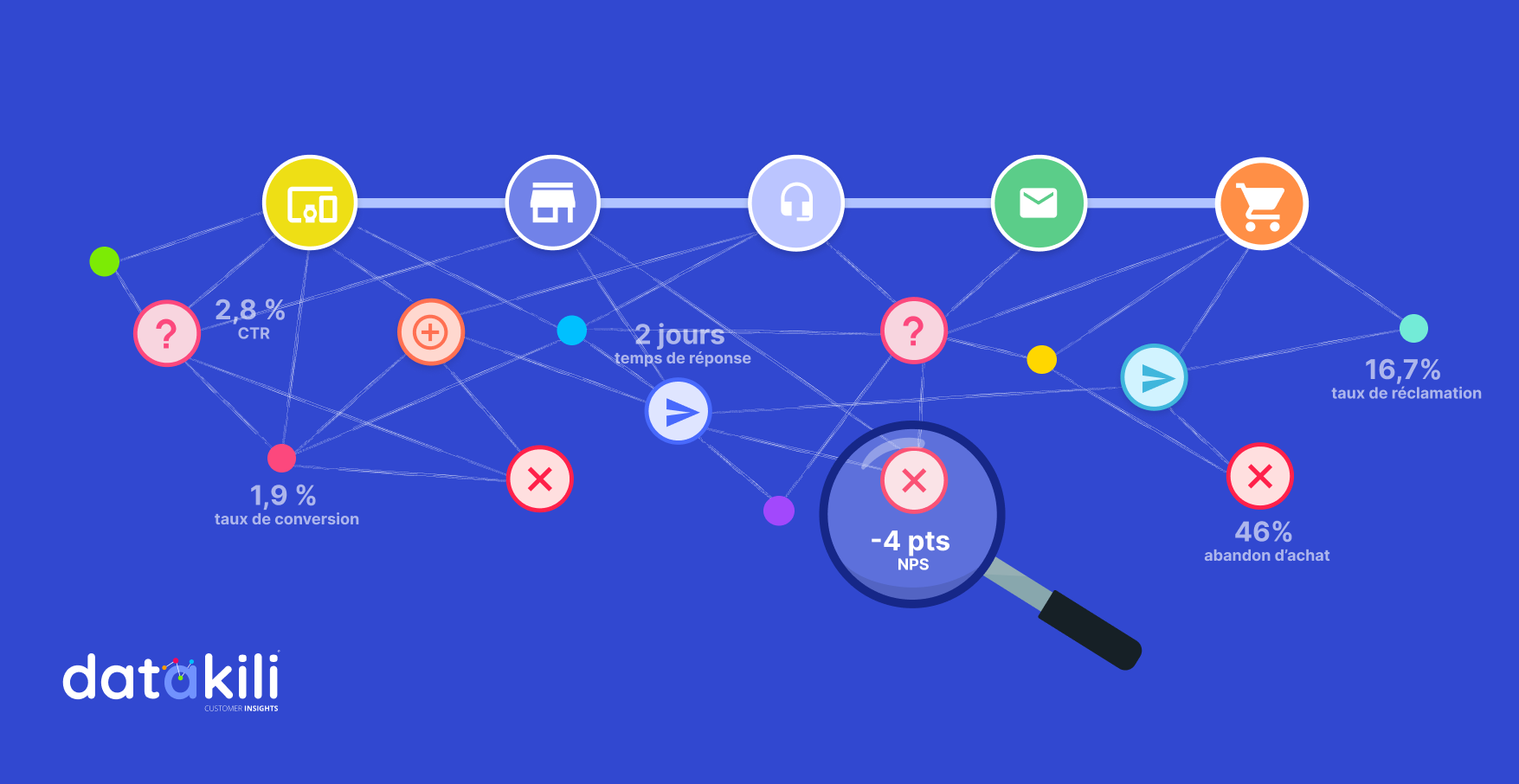
CX: The Hidden Trap of Customer Journeys… That Don’t Actually Exist
Optimizing your customer journeys? Be careful — two invisible mistakes can quietly destroy your efforts.
👉 In this article: how to avoid these traps and focus your CX investments where they actually drive ROI.
🎁 Bonus: a framework for connecting macro vision and micro analysis to manage the right journeys at the right level.
The Mirage of Idealized Journeys
In many organizations, customer experience is designed around typical journeys — modeling an “average user,” outlining key steps, and rolling out broad improvement plans.
But in reality?
Those journeys don’t exist.
And that’s where the trap closes.
Two common mistakes follow:
- Launching generic initiatives disconnected from real customer behavior.
- Investing heavily in optimizing fictional journeys that have little impact on conversion, loyalty, or profitability.
The issue isn’t ambition — it’s the ability to identify the right sub-journeys and activate the right behavioral levers.
What the Macro View Doesn’t Tell You
Executives need consolidated views to make decisions — to see overall flows, identify friction points, and prioritize investments.
But the macro view alone is not enough.
Behind every segment lie multiple real-life paths, shaped by:
- Diverse behaviors
- Implicit preferences
- Varying contexts of use
👉 Behavioral variation is the norm, not the exception.
And performance is hidden in that granularity.
What You Really Need to Manage
🎯 Focus on:
✅ Sub-journeys that drive value — or churn
🔍 Weak signals that precede drop-offs
🤯 Unexpected behaviors that break your standard models
To detect these, data alone isn’t enough.
You need structured journey intelligence and tools that can:
- Rebuild actual customer flows
- Detect recurring patterns
- Continuously model evolving personas
Macro + Micro: The Winning Combination
The goal isn’t to choose between a global view and detailed analysis — it’s to make them work together.
| Level | Objective | Approach |
|---|---|---|
| Macro (Strategic) | Prioritize and guide decisions | Analyze dominant flows and consolidated maps |
| Micro (Operational) | Personalize, anticipate, optimize | Behavioral segmentation, rupture detection, sub-journey mapping |
This dual strategic and behavioral perspective turns raw data into actionable CX intelligence.
What True Behavioral Mapping Enables
🚀 Act on real** journeys**, not statistical averages
💡 Allocate resources where the impact is tangible
🎯 Design experiences based on observed behaviors, not assumptions
Conclusion
Customer experience can no longer be managed through idealized journeys.
It must be driven by a living, behavioral map of what customers actually do.
That methodological realism makes all the difference — between a CX strategy that costs…
and a CX strategy that performs.
Discover our insights and expertise through our free resources.
👉 Contact us to learn how Datakili can help you structure, analyze, and activate your customer journeys for measurable performance.